Confirmed - These 3 Popular Holiday Items Are Far More Toxic Than You Think
The holiday season is all about warmth, comfort, and festive traditions — but some of the most common holiday items can secretly pollute your home, disrupt your hormones, and even harm your long-term health.
If you want a safer, cleaner, and truly joyful holiday season, here are three toxic products you should avoid (and the healthier alternatives you can use instead).
1. Scented Holiday Candles — A Hidden Source of Indoor Air Pollution
Scented candles may make your home feel festive, but they also release volatile organic compounds (VOCs) — including formaldehyde, one of the most dangerous indoor air pollutants.
A study published in Science of the Total Environment found that burning scented candles can produce up to 2,098 parts per billion of formaldehyde, far exceeding commonly accepted safe indoor levels. Even unlit candles can emit VOCs into your home.
Why it’s dangerous:
- VOCs accumulate indoors
- They can irritate the eyes, skin, and lungs
- Many fragrance chemicals act as endocrine disruptors
- Long-term exposure is linked to more serious health risks
Better alternative:
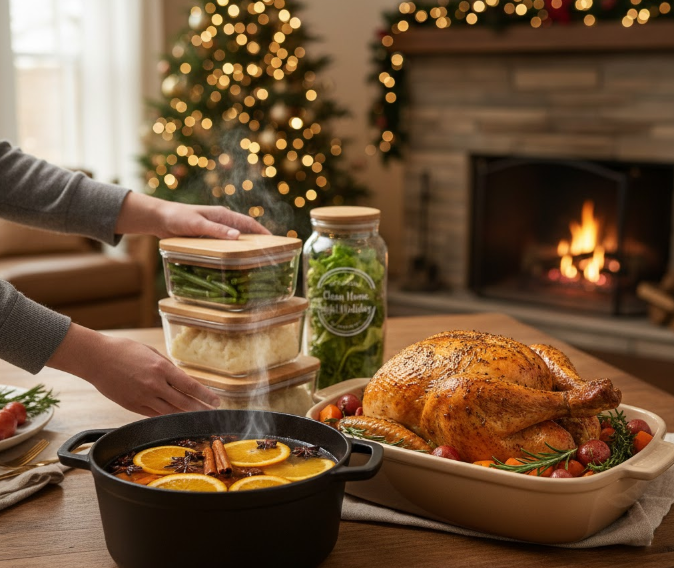
Choose beeswax or soy candles scented only with natural essential oils. Or skip candles entirely and use simmer pots with cinnamon, citrus, and cloves for a clean, natural aroma.
2. Plastic Turkey Basting Bags — A Major Source of Microplastics
Many families roast their holiday meals inside plastic basting bags — but new science shows that heating plastic is one of the greatest sources of microplastic and nanoplastic contamination.
A 2023 study published in Environmental Science & Technology revealed that heating plastic for just three minutes can release up to:
- 4.22 million microplastic particles
- 2.11 billion nanoplastic particles per square centimeter
These particles don’t stay in the bag — they migrate directly into your food.
Why it’s dangerous:
Microplastics and nanoplastics can:
- Damage cells
- Disrupt hormones
- Accumulate in organs
- Cross the blood-brain barrier
- Trigger long-term inflammation
Better alternative:
Skip the plastic completely. Use a Dutch oven, roasting pan, or oven-safe ceramic cookware to cook your holiday meals plastic-free.
3. Plastic Containers for Leftovers — A BPA and Microplastic Risk
Storing leftovers in plastic containers seems convenient, but it’s one of the most overlooked sources of chemical exposure in the home — especially if those containers are old, scratched, or exposed to heat.
Plastics can release chemicals such as BPA, phthalates, and other endocrine disruptors. Heating them (microwave, dishwasher, or hot food) increases the release even more.
Why it’s dangerous:
These chemicals are linked to:
- Hormone disruption
- Reproductive issues
- Metabolic changes
- Increased allergy and asthma risk
Better alternative:
Store leftovers in glass containers with bamboo or silicone lids. They last longer, don’t leach chemicals, and keep food fresher.
Protect Your Home — And Your Loved Ones
By eliminating just these three items from your holiday routine, you dramatically reduce indoor toxins, hormone disruptors, and microplastic exposure.
A healthier home = a happier holiday.
Sources
- Candles (Formaldehyde & VOC Study):
Science of the Total Environment
https://www.sciencedirect.com/science/article/abs/pii/S0304389414010243 - Plastic Basting Bags (Microplastics Study):
Environmental Science & Technology (ACS Publications)
https://pubs.acs.org/doi/10.1021/acs.est.3c01942